
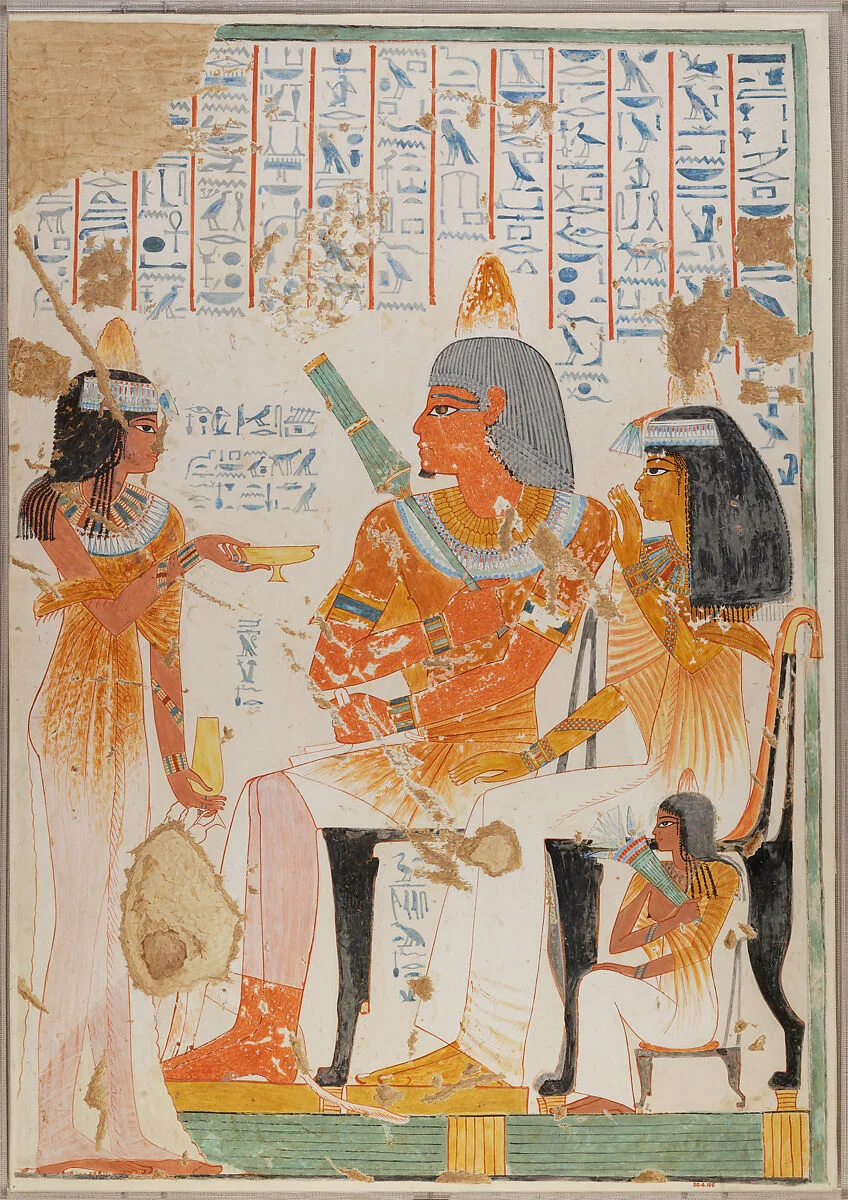
Alcohol as part of a desirable life
Beer as an everyday provision
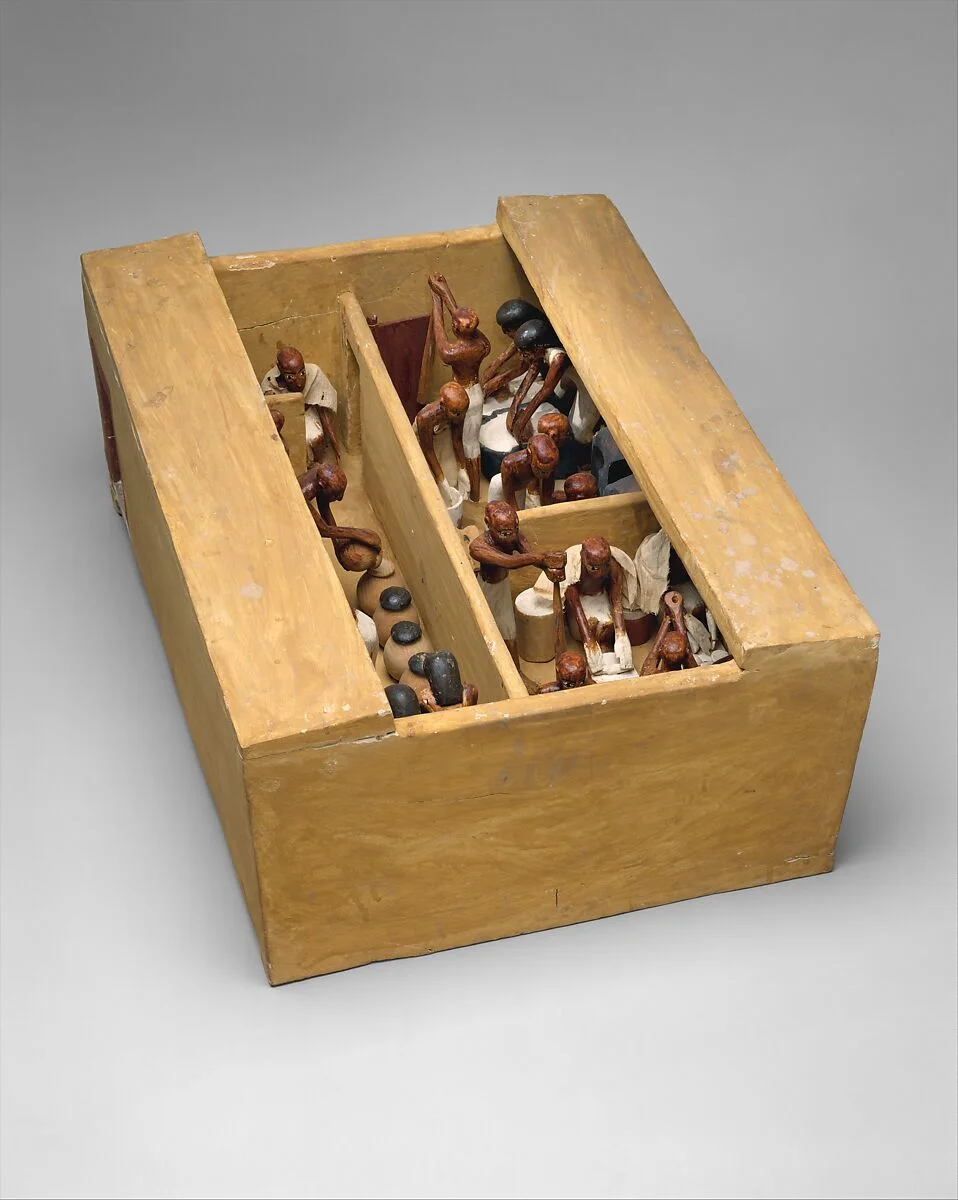
About six centuries before Nebamun's banquet was painted, a miniature bakery and brewery was placed in the tomb of the royal steward Meketre at Thebes, around 1980 BC. Inside a wooden building less than a metre long, painted figures crush grain, grind it and work beside vats and jars. Bread and beer are made in adjoining rooms.[2]
Before anyone could offer a bowl, someone had to prepare the grain, tend the mixture and fill the vessels. Meketre's comfort depended on those people. The model keeps them at their tasks even in the arrangements for his afterlife, reducing a working establishment to a scale that could accompany one man into his tomb.
Alongside bread, beer was a provision he expected to need, and its continued supply was worth securing. Its place here among the necessities of a comfortable afterlife tells us more about being well supplied than about a desire for intoxication.
A source of pleasure
At Elkab, farther up the Nile, the fifteenth-century BC tomb of Paheri gives the people around the wine bowls something to say. Among the female guests, Amen-sat turns down a drink. The attendant encourages her to celebrate and drink to drunkenness. Another guest asks for eighteen cups of wine and announces her wish to become drunk: “my inside is as dry as straw!” Elsewhere, an attendant persists with a reluctant drinker while a companion urges her not to spoil the entertainment.[3]
These are exchanges composed for a tomb, not an overheard conversation; the eighteen cups are a request, not a tally of drinks consumed. Around the guests, the decoration includes musicians, a dancer and women clapping. Wine accompanies the music and dancing; some guests are eager to drink, others reluctant.[3]
Offering wine is an act of hospitality, but an offer can become difficult to refuse. The attendants' persistence turns drinking into a question of how to behave towards the company. One woman's reluctance is met with encouragement; elsewhere a companion joins the effort to keep the bowls circulating. Accepting a drink can be presented as part of joining the pleasure of the gathering. Yet the refusal is also allowed into the picture: not every guest has been made to express the same appetite.
The woman who wants eighteen cups needs no such persuasion. She does not simply accept the wine; she announces that she wishes to become drunk. That desire has a place in a scene commissioned for a tomb, alongside the music and company, rather than being presented as an interruption to the entertainment.
The company is also more ordered than its lively conversation might suggest. The Egyptologist John Baines notes that some guests are identified as deceased, while rank is marked by the size of the figures and their seating. The privileged sit on chairs; others sit on mats, in groups separated by gender.[8] The wine circulates within a picture of society in which rank, family and the presence of the dead still matter.
Where Meketre's model secures a supply of beer, Paheri's scene gives drinking a social life, with relatives, attendants and entertainers gathered around the bowls. Their company, as much as the wine, belongs among the pleasures preserved in the tomb.
Drinking together
Beyond these commissioned banquet scenes, another gathering comes into view at Deir el-Medina, the village of the workers who built and decorated royal tombs near Thebes. An inscription preserved on several joined fragments records contributions to a drinking party associated with Hathor. It is attributed to the reign of Ramesses III or IV, in the twelfth century BC.[5][15] The record begins with a contribution from a woman named Isis, followed by a list naming at least thirty-three women and three men. Bread appears among the contributions, often five or ten loaves from one person.[15]
The precise occasion remains uncertain. Whether Hathor was the goddess or a woman has prompted different interpretations; Heidi Jauhiainen favours a woman because the name is accompanied by the sign for a seated female figure.[4][15] The contributors' list does not tell us who attended or whether anyone became drunk. It does, however, preserve something the painted conversations cannot: a record of what people gave to a shared drinking gathering. The company comes into view through names and contributions, rather than through the words chosen for guests on a tomb wall.
The unsettling effects of intoxication
The visible effects of excess
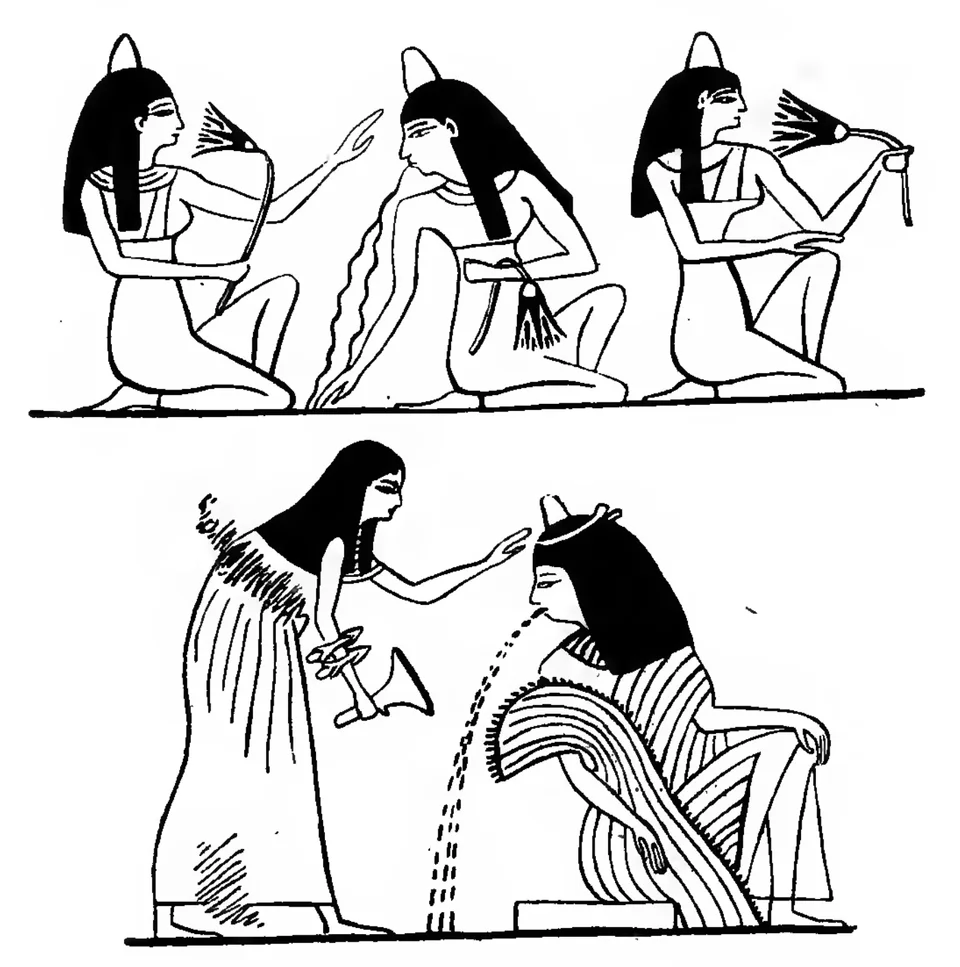
The banquet paintings do not invariably stop at the offered bowl. A detail from the Theban tomb of Amenemhat, dated to about 1479–1425 BC, shows a guest vomiting into a jar. The Metropolitan Museum's catalogue Drink and Be Merry! identifies this as the aftermath of excessive alcohol consumption.[7]
It is easy to read the picture as a warning. Baines suggests a different possibility when discussing another banquet, in the tomb of Djeserkareseneb, from around 1400 BC. There, a man vomits into a vessel provided for the purpose. Baines argues that such conduct could fall within accepted behaviour for the occasion; its inclusion might even lend the scene humour. The contrast between the guests' restrained poses and the messier effects of drinking need not have been intended entirely seriously.[8]
If Baines's reading is right, the guest who vomits remains part of a scene celebrating the pleasures of company. His loss of bodily control can be acknowledged, and perhaps found amusing, without turning the whole gathering into a lesson against drink. The vessel provided for him suggests that even this messy consequence belongs within the celebration as the painter presents it. This is not the same as saying that the conduct was admirable. It means that depicting excess need not be a way of condemning it.
Judgment and dignity
The Instruction of Ani tells its reader not to overdo beer. It then explains why: discreditable words may come out of his mouth without his awareness, he may fall and injure himself, and no one will offer a hand. Even his drinking companions distance themselves.[9]
This is an account of vulnerability as well as bad conduct. The speaker fears what a drinker may say, what happens to his body and how others will respond. The companionship that makes drinking attractive proves unreliable at the moment help is needed. Set beside Paheri's invitations, the warning changes our view of the group around the bowl: sharing a drink does not guarantee help when it is needed.
The surviving Boulaq manuscript dates to the Twenty-first Dynasty, roughly the eleventh–tenth centuries BC, although the work's composition is thought to be earlier. It belongs to a tradition of instruction about how to live and behave, not to a register of actual drinking incidents.[9] Its author selects an alarming outcome to make his advice persuasive.
Responsibilities neglected
A reprimand preserved in Papyrus Anastasi IV, copied around 1200 BC, turns from dignity to the demands of a scribal education. Its pupil has abandoned writing for pleasure and wanders about reeking of beer. The comparison with a boat whose steering gear is defective makes the accusation plain: he is no longer directing himself as he should.[10]
The speaker denounces wine and urges him to give up drink, not merely to drink less while working.[10] His advice is far more uncompromising than the invitations on Paheri's tomb walls.
Drinking has displaced the discipline expected of a future scribe. This is literary admonition, not the surviving disciplinary file of a known student, but the expectations behind it explain the force of the rebuke. What Paheri's guest seeks as enjoyment, the admonisher presents as a way to squander one's abilities.
In the banquet image, loss of bodily control may belong to the occasion's humour; in the reprimand, it becomes part of an accusation. The pupil is not merely shown in an undignified state; he is told to change. Ani likewise makes uncontrolled speech, injury and abandonment into reasons to fear excess. A reader might find a drinker's predicament comic and still recognise the force of the criticism. Humour and disapproval need not be opposites: the difference is whether the drinker's distress becomes an argument for changing his conduct.
The sacred significance of intoxication
Intoxication saves humanity
In the story usually called The Destruction of Mankind, the sun god Ra has grown old and humanity rebels against him. He sends his daughter Hathor to punish the rebels. When he wishes to spare those who remain, he has beer mixed with red ochre and spread over the land. The goddess drinks the blood-coloured liquid until she is intoxicated, and the killing stops.[11]
The episode forms part of the Book of the Heavenly Cow, whose fullest surviving version was inscribed in the tomb of the pharaoh Seti I in the thirteenth century BC. Its events belong to divine time: the larger story explains the separation of gods and humans and the reordering of the cosmos.[11]
For the people threatened by Hathor, her drunkenness is a reprieve. Ra has unleashed a force whose violence he no longer wishes to continue. Beer succeeds where the original command to punish has become a danger to those who survive: it changes the goddess's condition, and with it the fate of humanity. The loss of control feared in the scribal warnings has a saving purpose here. That does not make the myth a record of human drinking ceremonies, but it gives a religious account in which intoxication stops a dangerous goddess from doing further harm.
A sacred place for drunkenness
At the temple of Mut in southern Karnak, on the east bank of the Nile at Thebes, the evidence takes a more material form. Between 2004 and 2007, a Johns Hopkins University and Egyptian expedition uncovered column drums beneath the temple's western side. These sections of stone columns belonged to a building associated with Hatshepsut and Thutmose III, around the 1470s BC. In Betsy Bryan's translation of the dedication, Hatshepsut made a columned “portico of drunkenness” for Mut.[12]
What survived was not an intact hall in which archaeologists could retrace a festival, but architectural fragments carrying a remarkable name. A royal dedication had given drunkenness a place in the goddess's temple. Unlike the rebuke to the pupil, this inscription does not invoke intoxication to describe disgrace. It connects it with something a ruler considered worthy of providing for a deity.
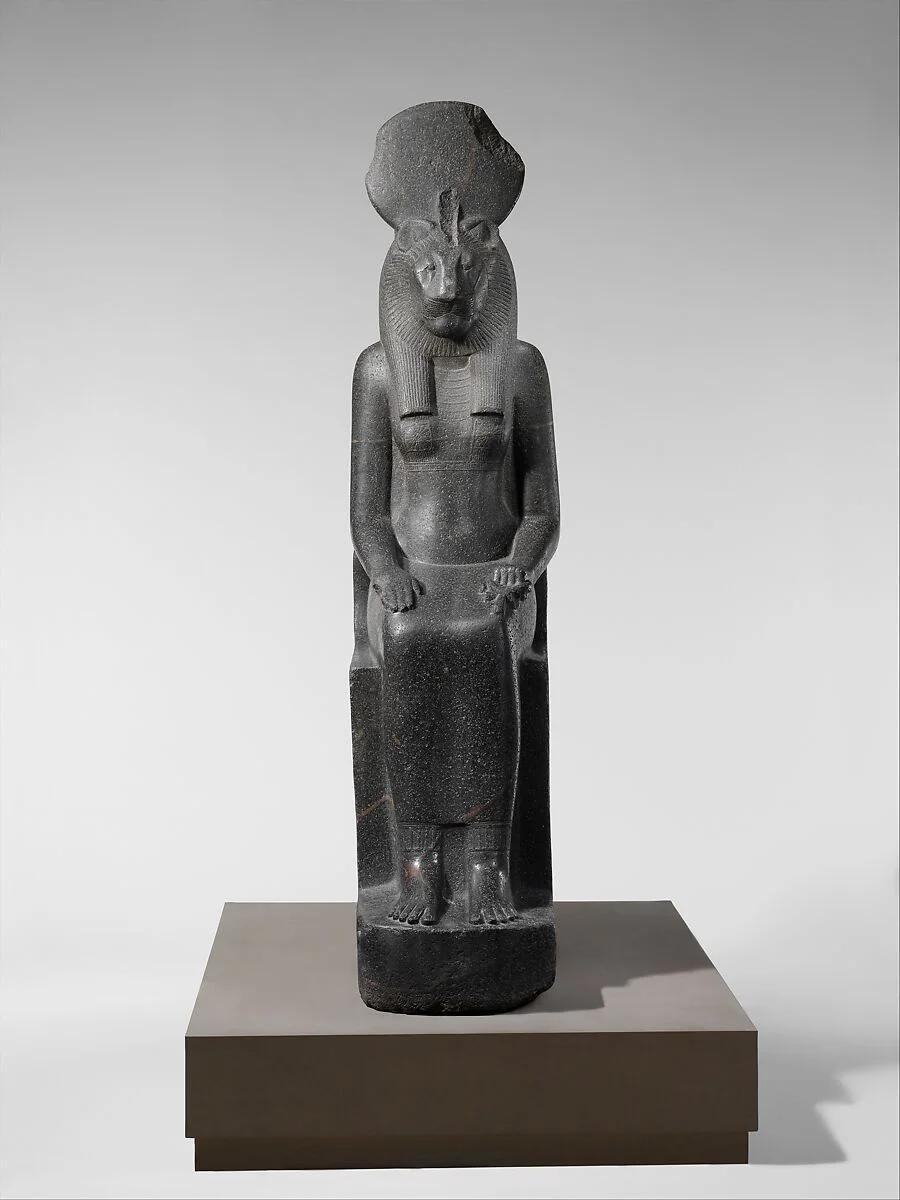
The goddess honoured here is Mut, rather than the Hathor of the myth. Mut was closely associated with the lioness-headed Sakhmet, whose powers could harm as well as protect. The many statues of Sakhmet made under Amenhotep III in the fourteenth century BC have been interpreted as a sustained effort to appease her.[13]
The inscription names the space without describing its ceremonies. A festival calendar from the Ptolemaic era, more than a millennium after Hatshepsut, describes red-tinted beer cheering Mut's heart and drawing her out of anger.[12] Coloured beer again helps appease a dangerous goddess, but the calendar cannot supply an exact programme for the much earlier portico. Nor does the myth establish that a ceremony there reenacted it: Hatshepsut's building predates the surviving copies of the Book of the Heavenly Cow, although the story itself may be older.[11][12]
Religious drinking together
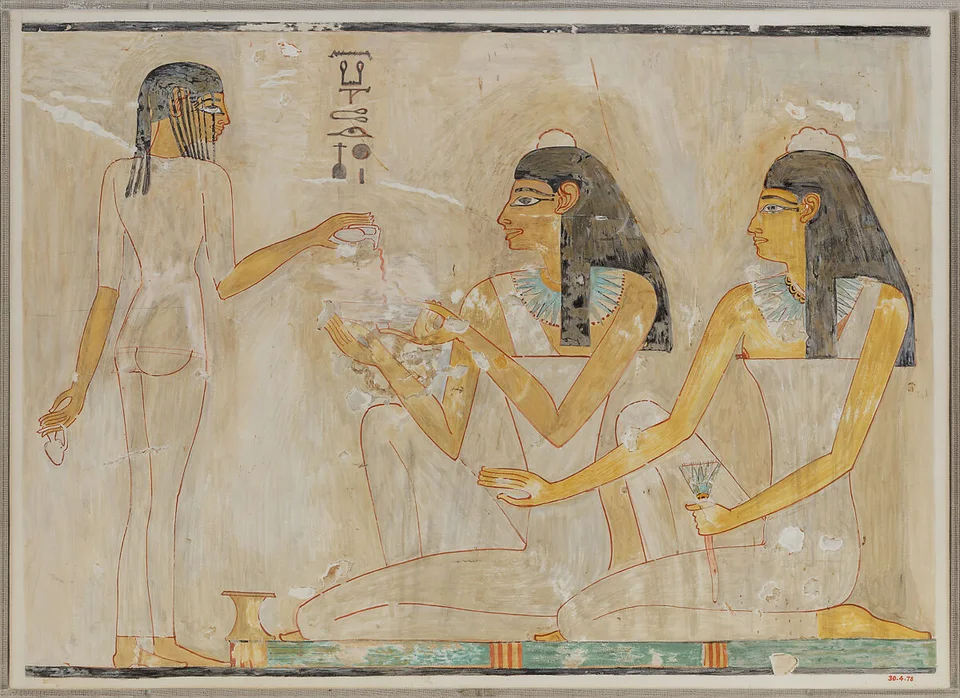
A song in the tomb of Horemheb, a military scribe who lived under Thutmose IV in the early fourteenth century BC, describes celebration, adornment and joy. This is the official buried in Theban tomb TT78, not the later pharaoh of the same name. The song tells of Mut's return and her sistrum players “desiring drunkenness from a goblet of gold,” in Bryan's translation.[12]
The sistrum was a ritual rattle, played by shaking it.[14] The song's invitations to adorn oneself and join the celebration in joy give the musicians' desire its setting. It describes more than the serving of a drink at a religious gathering: becoming drunk is something to look forward to as the goddess returns.
Bryan interprets such songs as evidence that people sought encounters with a goddess and, in funerary celebrations, with the dead through intoxication.[12] On this reading, becoming drunk could promise more than pleasure in company: it offered the possibility of approaching beings beyond everyday human reach. The altered state could help fulfil a religious aspiration, rather than simply interrupt the ordinary duties criticised in the scribal rebuke. This is an interpretation of what celebrants hoped for, not a record of what each person experienced.
The song supplies a human desire where the myth describes a goddess and the dedication names a building. Taken together, they give intoxication a place in religious life that a warning against excess alone would conceal. They do not describe one ceremony, and the song does not identify Hatshepsut's portico as its setting. Their force lies in the different ways they connect drunkenness with divine power and human hopes.
Worship also brought people together. Music had to be played and drink served; the pleasures of company could accompany the wish for divine favour. Seeking a goddess and enjoying the presence of other people need not have been competing purposes. Beyond these gatherings, festival processions could bring divine images out of restricted sanctuaries and along routes where a wider public could approach them, even when the temple's inner rooms remained closed to most people.[7]
The surviving voices still leave much of that social life beyond our reach. Meketre's model shows brewers at work but tells us nothing of their thoughts about the beer they made. Paheri's guests have words chosen for them; the scribal pupil receives a rebuke rather than a chance to reply. The Deir el-Medina fragments offer a glimpse of another gathering, but many more people made, served and shared drinks without leaving an account that has reached us.
Living with a powerful drink
The bowl offered to Nebamun promises pleasure and company. The scribal pupil faces a different demand: losing command of himself means failing at what he is expected to become. In the song to Mut, by contrast, the desire for drunkenness belongs within the celebration of a goddess.
The warnings about injury, humiliation and abandoned responsibilities do not lose their force beside the song. But where the warning imagines a drinker cut off from help, Bryan's reading of the song finds people hoping to approach the divine. The change in consciousness that made drunkenness troubling elsewhere could itself be a reason to seek it.
References
- The Metropolitan Museum of Art. Nebamun Receiving Wine, 30.4.106. Nina de Garis Davies, 1916 facsimile; original in TT181, about 1386–1330 BC. Object record. The opening invitation follows the museum's English rendering.
- The Metropolitan Museum of Art. Model Bakery and Brewery from the Tomb of Meketre, 20.3.12, about 1981–1975 BC. Object record.
- Tylor, J. J., and F. Ll. Griffith. The Tomb of Paheri at El Kab. London: Egypt Exploration Fund, 1894, pp. 23–26, especially p. 25, plate VII. Published with Édouard Naville's Ahnas el Medineh. University-held edition.
- Donker van Heel, Koenraad. “Women Can Party Too.” In Mrs. Naunakhte & Family: The Women of Ramesside Deir al-Medina. Cairo: American University in Cairo Press, 2016, pp. 137–148. Publisher's abstract, outlining alternative interpretations of the gathering.
- Demarée, Rob, Kathrin Gabler, and Stéphane Polis. “A family affair in the community of Deir el-Medina: gossip girls in two 19th dynasty letters.” In Svenja A. Gülden, Tobias Konrad, and Ursula Verhoeven, eds., Ägyptologische „Binsen“-Weisheiten IV: Hieratisch des Neuen Reiches: Akteure, Formen und Funktionen. Stuttgart: Franz Steiner Verlag, 2022, pp. 43–126, especially p. 105 and notes 195–196. Institutional record; open article. Joined ostracon: O. Cairo CG 25705 + O. IFAO 1322 + O. Varille 38 + O. DeM 10363.
- The Metropolitan Museum of Art. Women at a Banquet, 30.4.78. Nina de Garis Davies, 1925 facsimile; original in Rekhmire's tomb, TT100, about 1479–1425 BC. Object record.
- Stünkel, Isabel. Drink and Be Merry!. Gallery rotation catalogue, 2019–2021. The Metropolitan Museum of Art. Catalogue, especially printed p. 1 / PDF p. 6.
- Baines, John. “Not Only with the Dead: Banqueting in Ancient Egypt.” Studia Universitatis Babeş-Bolyai, Historia, 2014, pp. 1–34, especially pp. 8–9. Oxford Research Archive record; accessible article copy.
- Dils, Peter. Die Lehre des Ani, papyrus Boulaq 4, version B. Thesaurus Linguae Aegyptiae. Text and manuscript information; 17.6–17.9, sentences 83–90. English paraphrase of the corpus's German translation.
- Dils, Peter. Vorwürfe an einen Schreibschüler mit zügellosem Verhalten, Papyrus Anastasi IV, recto 11.8–12.5, British Museum EA10249. Thesaurus Linguae Aegyptiae. Text and manuscript information; sentence translations, especially 11.8–12.2. English paraphrase of the corpus's German translation.
- Guilhou, Nadine. “Myth of the Heavenly Cow.” UCLA Encyclopedia of Egyptology, 2010. Scholarly account, witnesses and editions, especially the narrative and ritual discussion.
- Bryan, Betsy M. The Altered State of Religion: Sekhmet and Ritual Revelries in the Reign of Amenhotep III. American Research Center in Egypt lecture, 30 September 2020. Transcript, PDF pp. 2–4 on the Mut-temple inscription and later festival calendar, and p. 8 on Horemheb's song. The TT78 song follows Bryan's translation of the monument published by Annelies and Artur Brack, Das Grab des Haremheb: Theben Nr. 78, 1980, plate 32a.
- The Metropolitan Museum of Art. Statue of the Goddess Sakhmet, 15.8.2, reign of Amenhotep III, about 1386–1347 BC. Object record.
- The Metropolitan Museum of Art. Arc sistrum of Tapenu, chantress of Sobek of Khenyt, 68.44. Object record and explanation of the instrument.
- Jauhiainen, Heidi. “Do Not Celebrate Your Feast Without Your Neighbours”: A Study of References to Feasts and Festivals in Non-Literary Documents from Ramesside Period Deir el-Medina. Doctoral dissertation, University of Helsinki, 2009, pp. 259 and 281. University record; full dissertation.
- Wilkinson, John Gardner. Manners and Customs of the Ancient Egyptians, vol. II. London, 1837, p. 167, woodcuts 146–147. Original edition and public-domain record. Reproduced in Henry Frederick Lutz, Viticulture and Brewing in the Ancient Orient (Leipzig: J. C. Hinrichs, 1922), p. 99, figures 22–23. Source of the cropped reproduction.
The four Metropolitan Museum illustrations are marked Public Domain in the museum's object records and are available under its Open Access / CC0 policy. The historical drawings after Wilkinson are a separately credited public-domain reproduction.