
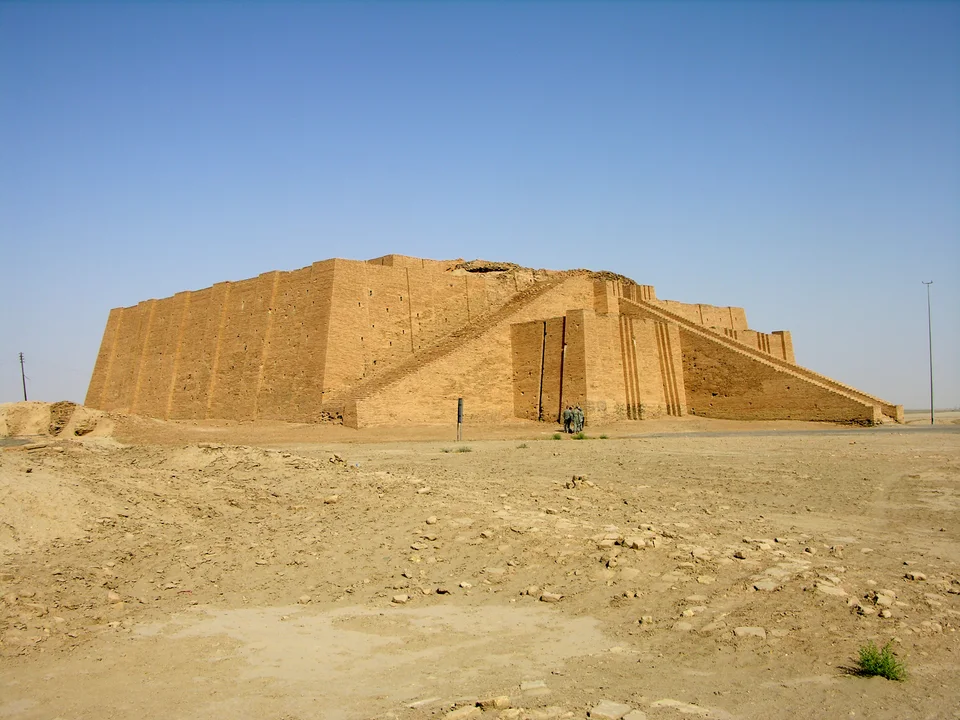

Mesopotamia is the land between the Tigris and the Euphrates, in what is now Iraq. It was in the southern part of this land — a hot plain where farming depended on irrigation — that some of the world's first large cities took shape.
Cities depended on agricultural surplus: enough grain to support people who were not farming themselves — artisans, priests and scribes. Temples and other institutions managed substantial flows of grain, livestock, textiles and labour. At that scale, memory was no longer enough. Administrators needed records.
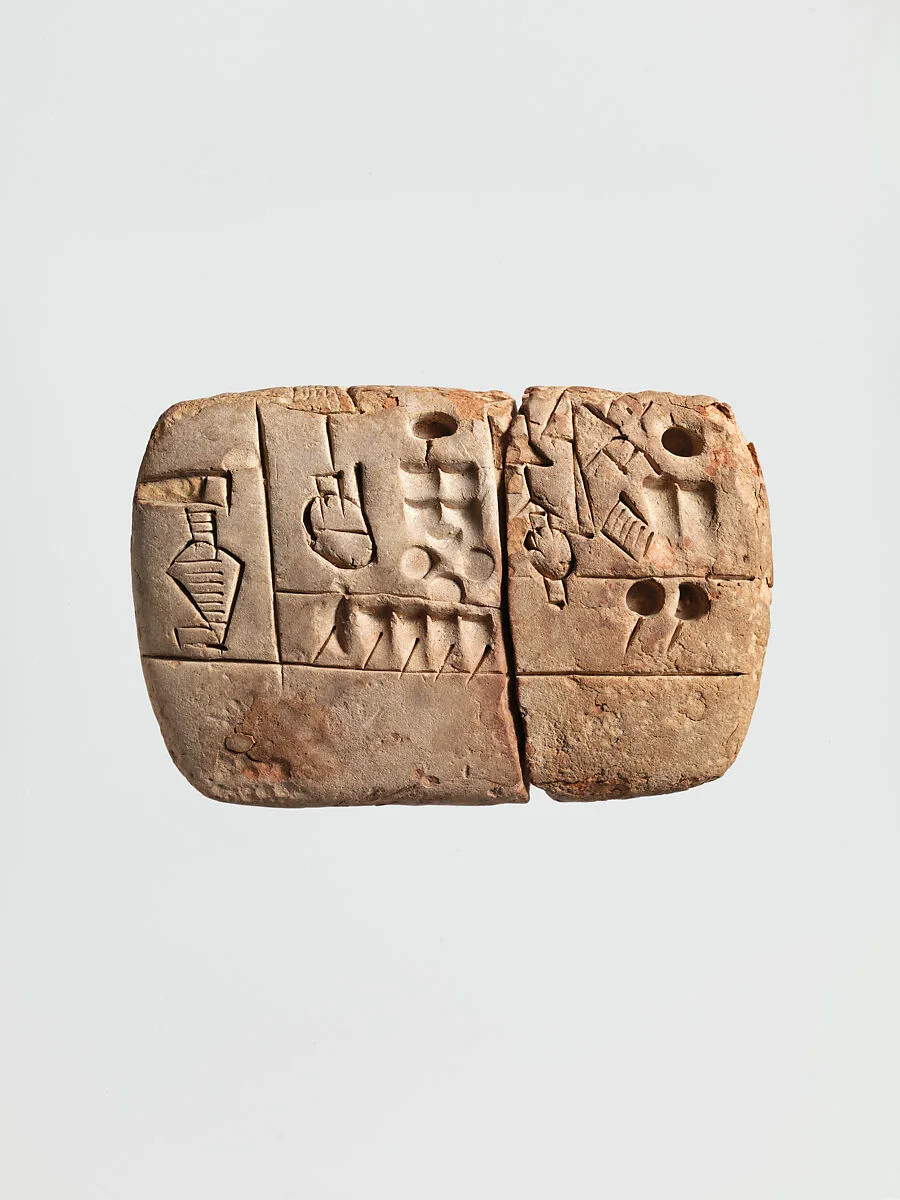
The earliest writing in southern Mesopotamia appears in precisely this administrative setting. The oldest surviving documents, dated to around 3200 to 3000 BC, are neither narratives nor poems: they are accounts.[2][3] Their signs, drawn or impressed into moist clay, were used first to record quantities, goods and categories rather than to transcribe speech sound by sound — a system specialists call proto-cuneiform. It is not an alphabet. Over the following centuries, its wedge-shaped signs — cuneiform proper — came to record words and syllables, then correspondence, hymns, myths and laws.[3]
For historians, writing changes what can be known. In Episode 1.1, the earliest fermented drinks were inferred from traces: altered starch grains in a mortar, acids absorbed into the wall of a jar. Everything depended on how those traces were interpreted. In Mesopotamia, a new kind of source appears alongside those clues: people begin to write.
And among the things the first administrators judged worth counting was beer.[2]
Beer enters the accounts
In the oldest tablets, beer does not appear as a novelty requiring explanation. It is already classified: variants of a sign resembling a jar correspond to nine categories interpreted as different kinds of beer, with ingredients counted separately, including products identified as malt and coarsely ground grain.[2] We cannot translate these categories precisely, but the distinctions themselves are clear. The accounting system was already specialized by commodity: on the archaic tablets studied by Salvatore Monaco, the notation of quantities varied so that a practised reader could identify barley or malt from the way the number was written.[4] Whatever those beer categories meant, they show that beer was already an established administrative commodity.
A thousand years later, under the Third Dynasty of Ur — around 2100 to 2000 BC — the documents let us follow grain into the breweries and beer out of them. A single large account studied by Peter Damerow records deliveries approaching 300,000 litres and carries forward a deficit from the previous period.[2] Beer had become an accounting obligation: quantities could be due, delivered and carried forward. Behind these volumes, people appear — brewers in the service of palaces and temples, several of whom validated their transactions with a personal seal.[5]
Who received the beer also complicates one of the most repeated claims about Sumer: that workers were paid in beer. Neumann's Ur III evidence shows that regular compensation for palace and temple workers was primarily barley, issued monthly, plus an annual wool ration. Beer appears instead in special distributions tied to travel, particular assignments or circumstances in which recipients could not prepare their own rations. An Umma account records flour and monthly beer rations for thirty-nine deported women and ten children, who, according to Neumann, received ready-to-consume provisions because they had no household in which to prepare their own meals. Travellers were provisioned in much the same way.[5]
Around 2050 BC, in Umma, a scribe keeps the accounts of supplies for travellers on official business. On a clay tablet he records what a man named Agu'a received, apparently en route to Elam: bread, oil, three fish, three bunches of onions, good-quality beer, and a jar of a brewing product called dida.[1] In these messenger accounts, the quantities varied with the traveller's function and rank.[5] No one intended to inform us about Agu'a. But because the accounts had to be kept, we know his name, what he drank, and why he received it — a precision prehistory never supplies.
These documents were nonetheless produced mainly by temples and other institutions for their own administrative needs. Studying Ur between about 3000 and 2600 BC, the archaeologist Giacomo Benati stresses how invisible independent artisans and villagers remain in the written record.[6] That temples counted their beer does not demonstrate they controlled everything brewed around them.
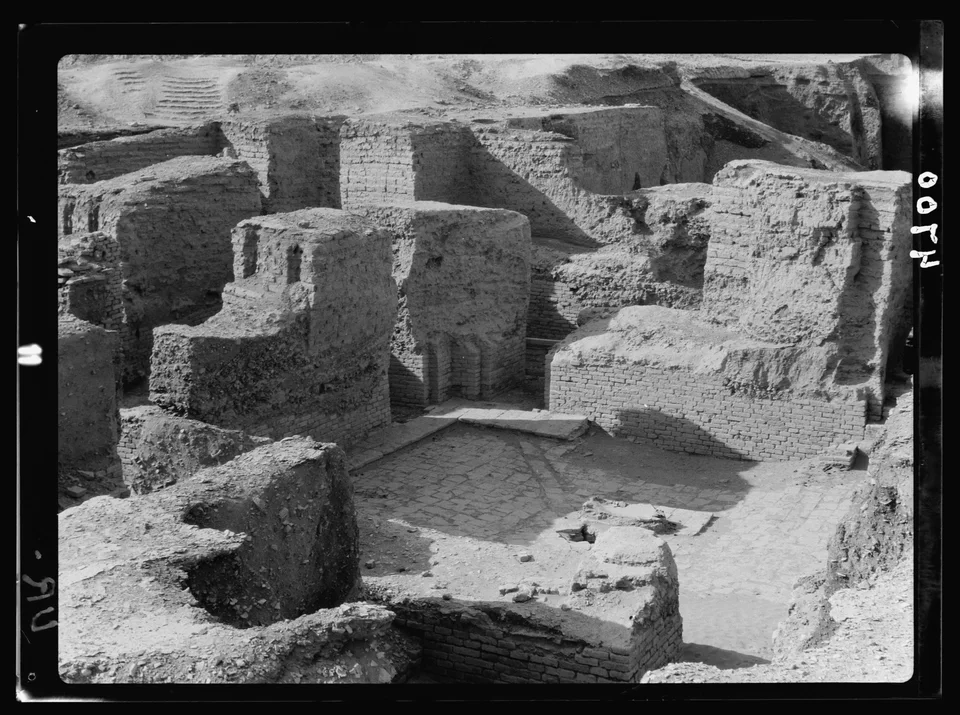

Even where the figures are precise, they do not describe what they measure: at Lagash, around 2350 BC, Damerow noted monthly grain issues that barely varied for more than ten years, a regularity that resembles an administrative quota more than a record of successive brewings.[2]
This is the limit of these archives. They tell us a great deal about quantities, categories and obligations; they tell us surprisingly little about what was actually in the jar.
What was this beer like?
To reconstruct the drink, historians have to start with the vocabulary in the accounts — and many of those terms are still difficult to interpret. Barley is the clearest ingredient. As with the prehistoric preparations of Episode 1.1, it required treatment: the grain contains mostly starch, which must be broken down into sugars before yeasts can turn them into alcohol. Letting barley germinate produces malt, whose enzymes accomplish part of that work.[2]
The difficulty begins with bappir, commonly translated as "beer bread." The translation immediately conjures an image: a baked loaf, then crumbled into water. It may be correct. But the accounts generally measure bappir by volume, not by the number of loaves — an odd way to count bread.[2] "Beer bread" is therefore a hypothesis disguised as a translation.
The texts name many beers without telling us what they were like. Documents dated to around 2500 BC distinguish categories rendered as dark beer, dark and sweet, red, or filtered; Ur III accounts commonly speak of ordinary beer and good beer.[2] These words classify without describing. "Good" tells us nothing about alcohol content, and "filtered" does not say how clear the liquid was. Reconstructions that present Mesopotamian beer as a thick, weak drink akin to kvass, or conversely as a strong ale, go further than the sources allow.
There is no evidence that hops were used, so we should not imagine the familiar bitterness of many modern beers.[2][7] Some preparations likely kept cereal particles in suspension. This may help explain the long drinking straws shown in Mesopotamian images: a straw could draw liquid from below the surface while avoiding sediment at the bottom.[2][7] That does not mean every beer was cloudy, or that everyone drank this way.
The most famous written clue is the Hymn to Ninkasi, a Sumerian poem addressed to the goddess of brewing, known from copies written around 1800 BC. It names dough, an oven, malt and vessels in a sequence that resembles a brewing process. But it is a hymn, not a manual: it does not say when malt and bappir were combined, and Damerow even doubts that the operations described follow the order of a complete brewing.[2][9] Translation creates another problem. Modern translations use words such as malt, wort, or mashing, which belong to the technical vocabulary of contemporary brewing. To read the hymn in our languages is already to read it through a modern brewery. Without a reliable recipe, researchers have turned to experimental brewing: experiments based on much later installations have shown that brewing in large, partly buried jars was technically possible, without thereby recovering a "Sumerian beer."[2]
We are left with a curious asymmetry: accountants able to distinguish and quantify several kinds of beer with remarkable precision, yet historians unable to say with certainty what a single one tasted like. And even if we could reconstruct the drink, that would not tell us what drinking meant to the people who consumed it.
Shared, sung about, regulated
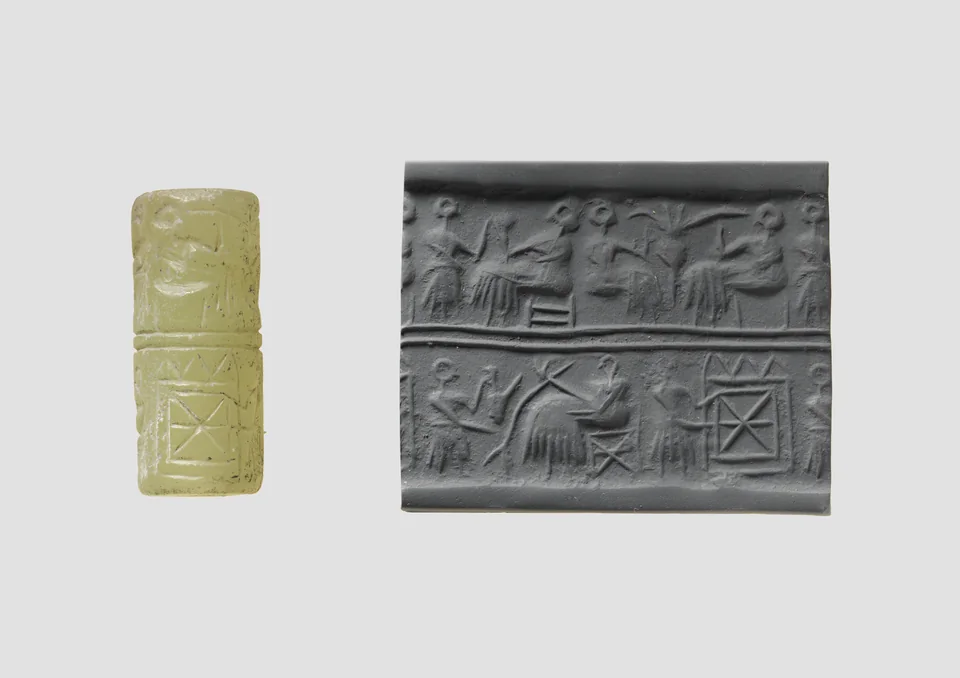
To see people actually drinking, we have to turn from accounts to images. A lapis-lazuli cylinder seal found in the tomb of Puabi, in the Royal Cemetery at Ur, around 2600 BC, packs two banquet scenes onto a seal only a few centimetres high. When rolled across clay, it produces two registers of figures: above, seated guests drink through long straws from a large vessel; below, others hold cups while servants attend them.[8] The shared jar is generally associated with beer, while the cups could contain wine, and we cannot identify each drink. But one thing is unmistakable: the difference between those who sit and those who serve. The drinking is communal, but the scene is clearly hierarchical.
Such an object comes from a richly furnished tomb, a reminder that Mesopotamian art first shows us the powerful. Yet people drank together far from royal tombs: excavations at Ur have yielded a considerable quantity of mass-produced cup fragments, dated to around 2900 to 2700 BC, from houses, rubbish deposits and graves. Benati interprets their abundance as evidence of collective drinking, perhaps linked to shared labour — at harvest time, a host able to offer food and beer could gather more hands than a single household could supply.[6]
Written sources from the court are similarly weighted toward elites: a hymn of praise shows Shulgi, king of Ur around 2050 BC — roughly Agu'a's time — drinking in a palace with the sun god Utu and the goddess Inanna at his table.[5] The scene is not the record of a meal; the choice of companions chiefly expresses the relationship the king claims with the gods. Beer also belonged to religious life: it was offered in rituals, and brewing had its own goddess, Ninkasi.[5]
The hymn addressed to Ninkasi reads very differently once we stop treating it as a recipe. It is a poem. Each pair of verses repeats the goddess's name as a refrain. Its imagery is strikingly concrete: a large shovel, an oven, reed mats, a vessel whose sound is said to be pleasant. And the poem concludes with the beer that flows: "It is you who pour out the filtered beer of the collector vat; it is like the onrush of the Tigris and the Euphrates."[9] The two rivers that made agriculture possible in this plain here serve to describe a liquid being poured. A society does not compose such lines for a drink that does not matter.
Literature also describes the effects of drunkenness. In the Sumerian narrative Inana and Enki, the visiting goddess is received with food, water and beer; Enki drinks with her and cedes divine powers tied to human institutions and skills, including kingship. When the effects wear off, he asks his minister where those powers have gone.[10] The myth does not tell us the strength of ordinary beers, but it shows that intoxication and its consequences were familiar enough to drive the plot of a myth.
The written record also takes us into the tavern. An Ur III document cited by Neumann mentions a credit contract concluded at a tavern-keeper's.[5] People drank there, and they did business there.
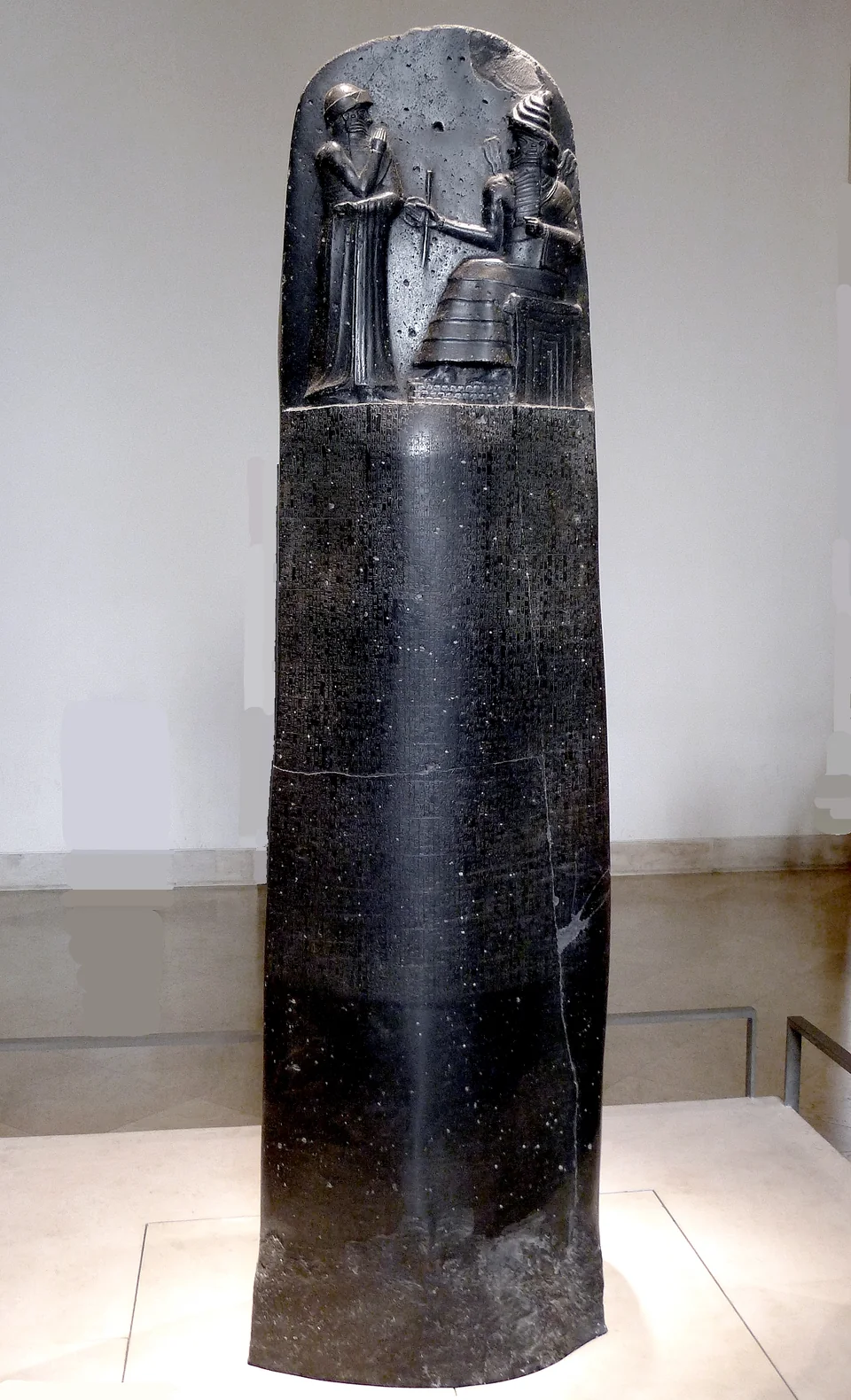
Several centuries later, around 1750 BC, Hammurabi's laws regulate both the sale of drink and what happened inside taverns. A provision, traditionally numbered 108, concerns the payment a tavern-keeper accepts, barley or silver, and the value of the drink served in exchange. The next prescribes the death penalty for a tavern-keeper who fails to arrest people plotting crimes in her house and hand them over to the authorities.[11] These are prescribed penalties, not trial records: they tell us what authorities wanted to regulate, not how people behaved. The need for such laws is revealing in itself. A drinking-house was a place where money changed hands and people gathered out of the authorities' sight.

What, in the end, did writing change?
Not certainty. An accountant is not an ethnographer: he records what the administration needs. A hymn is not a manual. A banquet scene is not a census. A law states what authorities wanted to regulate, not what people did. Even on basic questions such as how the beer tasted or how strong it was, Mesopotamia leaves us in uncertainty — and it cannot tell us when fermented drinks first appeared; they long predate Mesopotamia's cities.
What writing gives us is something different. For the first time in the history of alcohol, we can follow a drink across the institutions and social worlds of a complex society. Beer is counted by scribes, distributed by institutions, brewed by specialists, shared around communal vessels, depicted on seals, praised in poetry, offered to gods, sold in taverns and eventually regulated by law. Each source is partial and shaped by the purpose for which it was created. Together, however, they describe the same drinking culture from different angles. That overlap is new: prehistory offered us only traces, and always required inference.
The beer itself still partly eludes us. The culture around it no longer does.
Mesopotamia was not the only society to leave such a record. In the Nile valley, at the same period, another urban society was writing, brewing and keeping accounts.
References
- Johnson, J. Cale. "The Ur III Tablets in the Valdosta State University Archives." Cuneiform Digital Library Journal 2006:2, §5. Scholarly edition. See also CDLI P273413 / VSU 05, transliteration and translation. Estimates of the jar's capacity differ between the edition and the current catalogue; the article therefore does not convert the jar of dida into litres. The professional title of the last recipient remains uncertain.
- Damerow, Peter. "Sumerian Beer: The Origins of Brewing Technology in Ancient Mesopotamia." Cuneiform Digital Library Journal 2012:2, 1-20. Full text. Especially §§1-3 on early writing and beer; §§4-5 on ingredients, accounts and categories; §5.8 on the large brewery account; §§6-7 on the hymn, experiments and the limits of reconstruction. The experiment of brewing in partly buried jars (Tall Bazi) is taken up through Damerow's critical discussion, not as a reconstruction of all Mesopotamian beers; the article does not name the site, whose context is much later than the southern Mesopotamia discussed here.
- Spar, Ira. "The Origins of Writing." Heilbrunn Timeline of Art History. Metropolitan Museum of Art, October 2004. Museum essay.
- Monaco, Salvatore F. "Unusual Accounting Practices in Archaic Mesopotamian Tablets." Cuneiform Digital Library Journal 2005:1, 1-7. Full text. Especially §§1-4 and 6.
- Neumann, Hans. "Beer as a Means of Compensation for Work in Mesopotamia during the Ur III Period." In Lucio Milano, ed., Drinking in Ancient Societies: History and Culture of Drinks in the Ancient Near East. History of the Ancient Near East / Studies 6. Padua: Sargon, 1994, 321-331. Open-access scan. See pp. 323-325 on compensation and brewers; pp. 325-327 on taverns, ritual and royal banquets; pp. 328-331 on particular distributions and messenger provisions.
- Benati, Giacomo. "Re-modeling Political Economy in Early 3rd Millennium BC Mesopotamia: Patterns of Socio-Economic Organization in Archaic Ur (Tell al-Muqayyar, Iraq)." Cuneiform Digital Library Journal 2015:2, 1-37. Full text. Especially §4.3.2 on the limits of the written sample and §§5.3.5-5.3.8 on drinking vessels, feasting and the possible mobilisation of labour.
- Paulette, Tate, and Michael Fisher. "Potent Potables of the Past: Beer and Brewing in Mesopotamia." The Ancient Near East Today 5, no. 4, April 2017. ASOR. Article page. Consulted in the version downloaded for this episode. This synthesis complements the ancient texts and specialist studies, especially on drinking equipment and the absence of evidence for hops.
- British Museum. "Cylinder seal," object 121545, registration 1928,1010.236, from the tomb of Puabi in the Royal Cemetery at Ur, around 2600 BC. Collection record. See also the description of the two banquet scenes and Damerow [2], figure 1.
- A Hymn to Ninkasi. Sumerian composition 4.23.1, English translation, Electronic Text Corpus of Sumerian Literature, University of Oxford. Text. Brewing imagery: lines 13-44; lines quoted: 45-48. The English quotation is the ETCSL translation ("It is you who pour out the filtered beer of the collector vat; it is like the onrush of the Tigris and the Euphrates"), not a direct rendering of the Sumerian. For the date of the copies and discussion of the translation, see Damerow [2], §§2.3 and 6.
- Inana and Enki. Sumerian composition 1.3.1, English translation, Electronic Text Corpus of Sumerian Literature, University of Oxford. Text. Especially segment C, lines 1-30, on reception and drink; segment D on the gifts; segment F, lines 1-18, after the effects of the beer wear off. This is literary evidence, not the account of a historical event.
- Laws of Hammurabi, §§108-109. Standard scholarly edition and translation: Martha T. Roth, Law Collections from Mesopotamia and Asia Minor, 2nd ed., Writings from the Ancient World 6, Atlanta: Scholars Press, 1997, chapter 8 ("Laws of Hammurabi"), pp. 71-142 — chapter unchanged from the 1st edition of 1995. The provisions are cited by paragraph number, a numbering stable from one edition to another. See also Neumann [5], p. 325 and note 45, for §109, and, for an open-access presentation, Alexandra N. Quinn, "Beer: Taverns and the Law," *CDLI Tablet* 551. The article paraphrases the provisions and distinguishes prescribed penalties from evidence of their application.