
We do not know who first made a fermented drink, or when or where it happened. No account or recipe records those beginnings, and the drinks themselves have disappeared. For prehistory, we know them only through what they left behind: microscopic residues, vessel wear, the context of an excavation.
Tracing the earliest drinks
Near Haifa, west of Galilee in northern Israel, Raqefet Cave opens in the limestone of Mount Carmel. Hunter-gatherers used it during the Late Natufian period, roughly 11,750–9750 BC.
To find out what had been prepared there, Li Liu, Jiajing Wang and their colleagues examined microscopic plant residues still clinging to three stone mortars. The mortars contained cereal starch from wheat or barley. Some grains showed damage resembling that found in barley allowed to sprout and then dried to make malt; others showed changes similar to those observed when the team crushed and fermented cereals in experiments. Samples taken for comparison from unused surfaces and from soil outside the cave contained almost none of these residues.[1]
Wear patterns and experimental reconstruction led Liu’s team to propose a brewing process: sprouting and drying grain to make malt, crushing and heating it in water, then allowing it to ferment. If they are right, some hunter-gatherers were fermenting grain around 11,000 BC, several millennia before cereal domestication in the Near East.[1]
That interpretation remains contested. In 2019, the archaeologist David Eitam argued that the mortars were used to mill barley for bread, and that the traces did not demonstrate beer production.[9] Liu and her colleagues replied that the residues, wear patterns and experimental results, taken together, still supported their reading.[10] Raqefet therefore remains possible evidence of early brewing, not a settled claim to the “oldest beer”.
Several millennia later, and thousands of kilometres farther east, the character of the evidence changes. At Jiahu, an early Neolithic village in China’s Henan province, Patrick McGovern and his colleagues examined organic residues from sixteen pottery vessels dating to roughly 7000–5500 BC.[2]
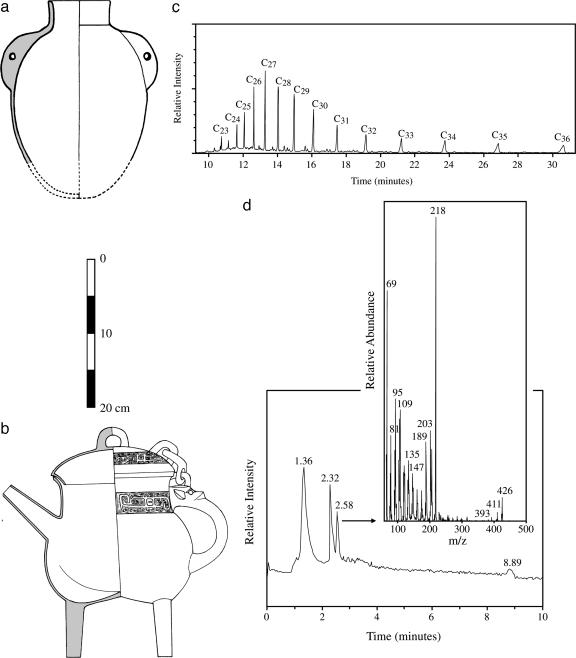
The team’s analysis pointed to a drink made from rice, honey and fruit. The results suggested the presence of rice, the only cereal recovered at the site, while compounds characteristic of beeswax pointed to honey. The fruit was harder to identify. Tartaric acid, detected in the residues, is commonly used as an indicator of grapes in the Near East, but some Chinese hawthorn fruits contain roughly four times as much of it as grapes do. Seeds of both hawthorn and wild grape had been found at Jiahu, leaving open the possibility that either fruit, or a mixture of the two, had been used.[2]
The liquid has disappeared, but the residues suggest that the drink had fermented. The combination of diluted honey, crushed fruit and naturally occurring yeasts could ferment without deliberate inoculation.[2]
If McGovern’s interpretation is right, people at Jiahu had learned to start fermentation deliberately by the early Neolithic, around 7000 BC.[2] They were already growing rice, although fishing, hunting and gathering still provided most of their food.[11]
There will be no inventor to name. Raqefet may push deliberate cereal fermentation much further back, while Jiahu provides clearer evidence that people were intentionally preparing fermented drinks by around 7000 BC. Neither site tells us when that knowledge first arose.
Different ingredients, different preparations
These prehistoric drinks do not always fit neatly into today’s categories of beer, wine, cider and mead. Jiahu makes that plain: a fermented mixture of rice, honey and fruit, rather than a drink that belongs to one modern family. Early preparations probably combined ingredients available locally, without necessarily resembling the recipes we associate with those drinks today. Grain processing illustrates how varied the possibilities could be, and how closely food and drink were connected.
Unlike fruit and honey, cereals contain mainly starch, which must be broken down into sugars that yeasts can turn into alcohol. Ways of preparing grain included roasting, grinding, soaking, cooking it as porridge and allowing it to sprout to produce malt. By learning to process grain in different ways, people could make both bread and fermented drinks.
Cultivation and domestication are not the same thing. People could sow and tend cereals that still retained their wild characteristics; domestication came later, as inherited traits such as ears that held onto their grains became established.[14] Evidence for bread or brewing before domestication therefore does not tell us whether the grain had been gathered from the wild or deliberately cultivated.
In 1953, the archaeologist Robert Braidwood asked whether the desire for beer had played some role in humans’ growing interest in cereals.[8] The possible brewing traces at Raqefet gave the question renewed force, but they do not settle it.[1] If Liu’s reading is right, some hunter-gatherers were fermenting wild cereals before domestication — and her team treats brewing as one possible use of the mortars among others.[1] Bread, however, is also attested before domestication. At Shubayqa 1 in eastern Jordan, charred food remains dating to around 12,450 BC have been identified as bread — older than the possible brewing traces at Raqefet.[7] Neither site proves that beer drove agriculture. What they show is that hunter-gatherers were already exploring several sophisticated uses of wild cereals.
Cereals were not the only ingredients people learned to ferment. In the valleys of the South Caucasus, evidence from the Georgian villages of Gadachrili Gora and Shulaveris Gora points towards grapes. These early Neolithic sites have yielded some of the Near East’s earliest large pottery vessels. A reconstructed jar from nearby Khramis Didi-Gora gives an idea of their scale: almost a metre high and equally wide, it could hold more than 300 litres.[3]
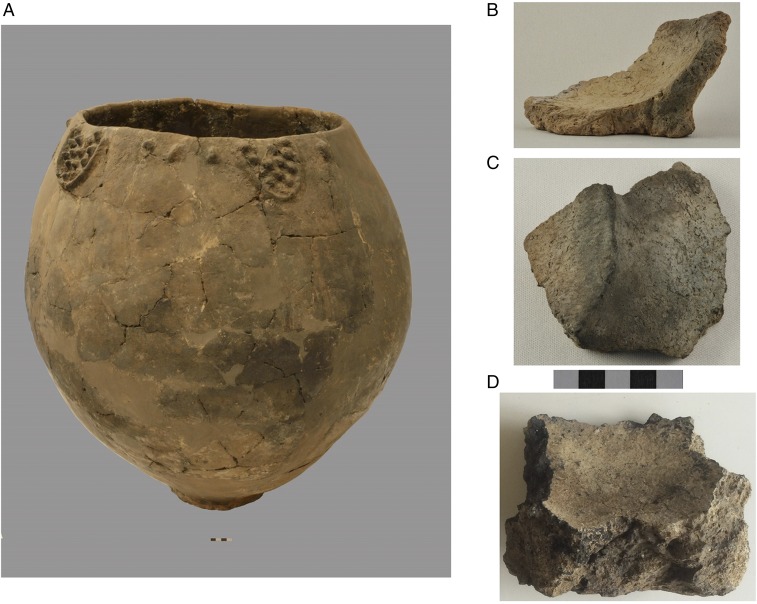
To find out what the jars had held around 6000 BC, McGovern and a team of Georgian and international researchers analysed fragments from comparable vessels. In several samples, concentrations of tartaric acid — the main organic acid in grapes — were much higher than in the surrounding soil.[3] Plant remains added to the chemical evidence. Grape pollen was found in soil layers dating to around 6000 BC but not in samples from the modern surface; microscopic remains of grapevine tissue were also identified in a similar jar. One pottery fragment preserved remains of fruit flies, which are attracted to sugar and alcohol. The researchers inferred that vines probably grew near the villages.[3]
Here the evidence allows a more precise identification: grape wine. The chemical and botanical findings complement one another, suggesting that people were making wine and storing it in large jars around 6000 BC, even though the liquid has disappeared.[3] This is not an evolutionary ladder from primitive mixture to beer to wine. These traditions developed in different places, from different ingredients. What they were making can be reconstructed, at least in outline. Why they drank it is a different question, and a harder one.
Drinking and communal life
Residues tell us what may have been in a vessel. Context is what allows archaeologists to ask how it might have been used. A pot found in a house suggests different possibilities from a mortar beside a grave or a large vat in a gathering place.
The mortars at Raqefet stood in a cemetery. Hunter-gatherers buried their dead in the cave with care: some graves were lined with flowering plants, perhaps chosen for their colour and scent.[6] Animal bones from the main burial pit suggest that the animals had been butchered and eaten, rather than buried whole as offerings. The bones bear few of the marks of trampling, burning or gnawing usually seen on household food waste left exposed for long periods. Reuven Yeshurun, Guy Bar-Oz and Dani Nadel interpret these as the remains of meals shared during funerals, the leftovers then collected and buried with the dead.[5]
Liu and her colleagues connect this evidence of meals with the traces they interpret as brewing. Two of the mortars they studied were close to human remains, raising the possibility that a fermented drink accompanied the funerals.[1] The cave’s use as a burial place is well established. That a fermented drink formed part of those gatherings is plausible, not proven.
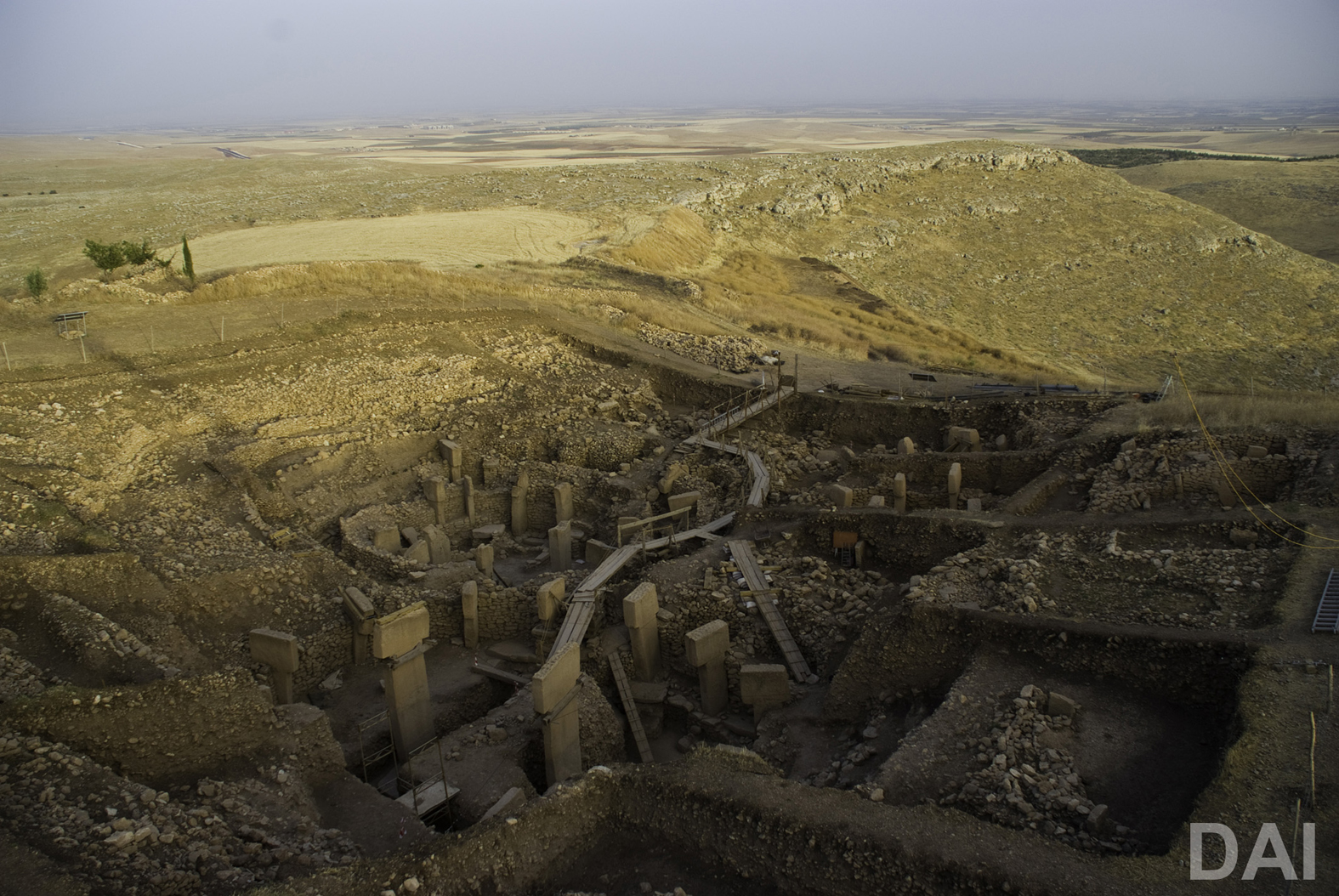
At Göbekli Tepe, on a hill in south-eastern Turkey, the question takes another form. There, hunter-gatherers erected monumental limestone structures around 9600–8200 BC: T-shaped pillars arranged in circles, some carved with animals, others given a stylised human form.[4] Building them required enormous collective labour. Oliver Dietrich and his colleagues interpreted the site in 2012 primarily as a sanctuary where groups gathered rather than as a settlement.[4] More recent excavations have complicated that picture: evidence of domestic activity now suggests a permanent settlement with a strong ritual component.[15]
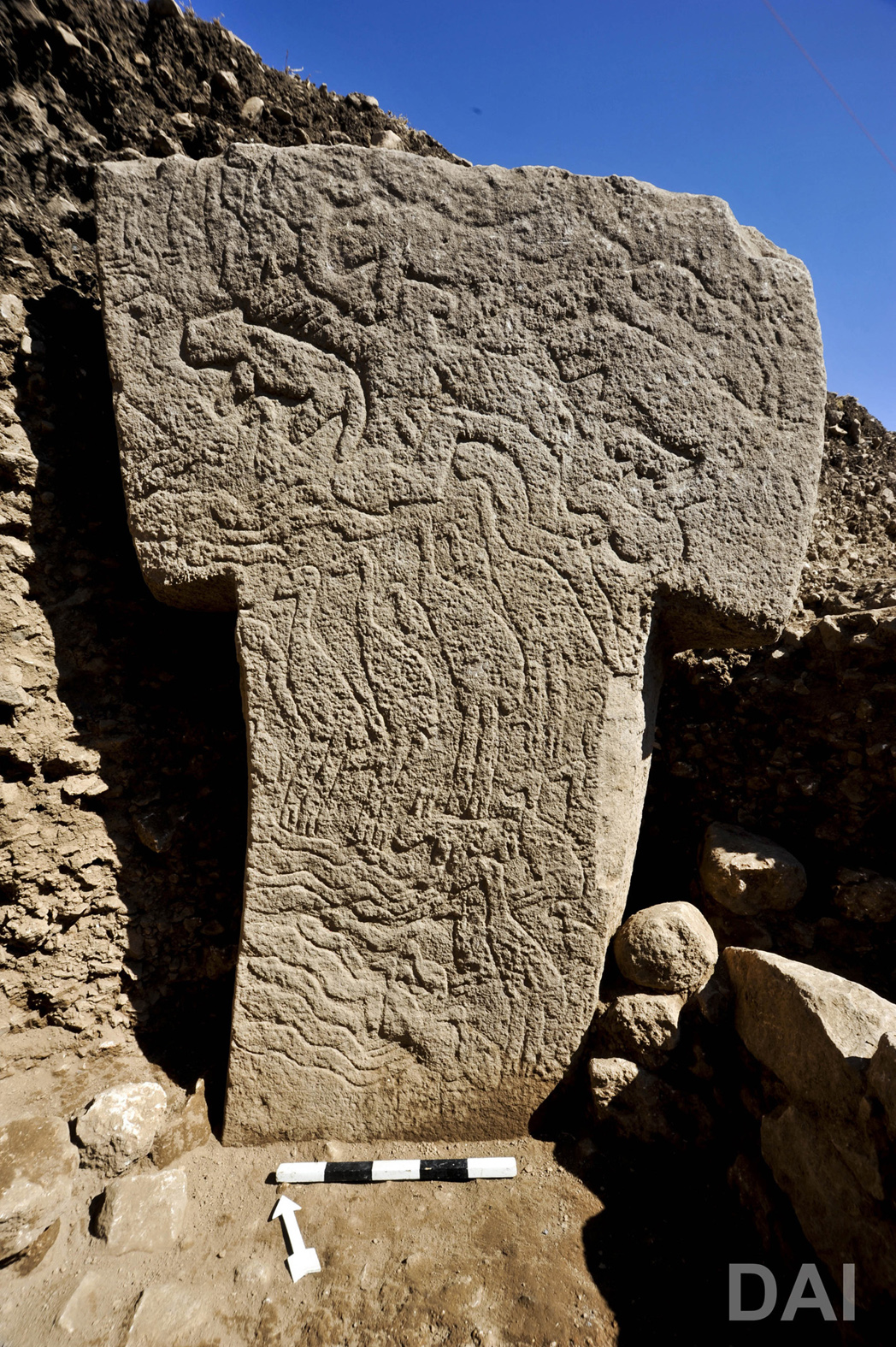
The earth filling the enclosures contained exceptional quantities of gazelle, aurochs and wild-ass bones, far more than usually found in settlements of the same period. Dietrich’s team read these as leftovers from large meals connected with construction: groups from the surrounding region gathering to eat and to help build.[4]
In rooms built later, the excavators found six limestone vessels shaped like troughs or vats, some capable of holding up to 160 litres. Grey-black deposits survived on their lower walls. Tests for oxalate — a salt that can form when crushed cereals are mixed with hot water during brewing — did not establish that the vessels had contained alcohol. Dietrich and his colleagues nevertheless considered the possibility that a cereal-based drink had been prepared or served during gatherings.[4]
Dietrich does not claim that alcohol built Göbekli Tepe. He argues that feasting may have helped mobilise labour and reinforce the relationships required for such collective projects. Construction could itself create the need for feasts, so ritual, food, cooperation and monumental work may have reinforced one another. Fermented drink is a possible component of that system, not its demonstrated cause.
Beginnings we cannot fully recover
The moment alcohol was invented cannot be recovered. Archaeology preserves only scattered traces: possible cereal brewing at Raqefet,[1][9][10] a deliberate mixture of rice, honey and fruit at Jiahu,[2] and clearer evidence of grape wine in Neolithic Georgia.[3] These dates tell us how old the surviving evidence is, not when people first learned to make fermented drinks.
What they do suggest is that alcohol was probably not a single invention. Fermentation already existed in nature. The human innovation was learning to recognise it, reproduce it and eventually control it — using different ingredients in different places. Grain, fruit and honey offered different routes to the same underlying process, and there is no reason to expect all of them to lead back to one inventor or one birthplace.
By the time fermented drinks become visible in the archaeological record, they also appear to be more than a way of processing food. At Raqefet, a fermented drink may have accompanied funerary meals.[1][5] At Göbekli Tepe, communal feasting is much better established than alcohol itself, which remains only a possibility.[4] The evidence becomes less certain here, but the question becomes more revealing: not simply how humans learned to make alcohol, but why drinking became worth repeating, sharing and embedding in social life.
For that question, the evidence soon changes completely. In Mesopotamia, people begin to write.[12] Administrative tablets record beer, its ingredients and its distribution, giving us a much closer view of what alcohol had become once it entered the world of cities, institutions and written memory.[13]
References
- Liu L, Wang J, Rosenberg D, Zhao H, Lengyel G, Nadel D. Fermented beverage and food storage in 13,000 y-old stone mortars at Raqefet Cave, Israel: Investigating Natufian ritual feasting. Journal of Archaeological Science: Reports. 2018;21:783–793. doi:10.1016/j.jasrep.2018.08.008
- McGovern PE, Zhang J, Tang J, Zhang Z, Hall GR, Moreau RA, Nuñez A, Butrym ED, Richards MP, Wang C-S, Cheng G, Zhao Z, Wang C. Fermented beverages of pre- and proto-historic China. Proceedings of the National Academy of Sciences. 2004;101(51):17593–17598. doi:10.1073/pnas.0407921102
- McGovern P, Jalabadze M, Batiuk S, Callahan MP, Smith KE, Hall GR, Kvavadze E, Maghradze D, Rusishvili N, Bouby L, Failla O, Cola G, Mariani L, Boaretto E, Bacilieri R, This P, Wales N, Lordkipanidze D. Early Neolithic wine of Georgia in the South Caucasus. Proceedings of the National Academy of Sciences. 2017;114(48):E10309–E10318. doi:10.1073/pnas.1714728114
- Dietrich O, Heun M, Notroff J, Schmidt K, Zarnkow M. The role of cult and feasting in the emergence of Neolithic communities. New evidence from Göbekli Tepe, south-eastern Turkey. Antiquity. 2012;86(333):674–695. doi:10.1017/S0003598X00047840
- Yeshurun R, Bar-Oz G, Nadel D. The social role of food in the Natufian cemetery of Raqefet Cave, Mount Carmel, Israel. Journal of Anthropological Archaeology. 2013;32(4):511–526. doi:10.1016/j.jaa.2013.09.002
- Nadel D, Danin A, Power RC, Rosen AM, Bocquentin F, Tsatskin A, Rosenberg D, Yeshurun R, Weissbrod L, Rebollo NR, Barzilai O, Boaretto E. Earliest floral grave lining from 13,700–11,700-y-old Natufian burials at Raqefet Cave, Mt. Carmel, Israel. Proceedings of the National Academy of Sciences. 2013;110(29):11774–11778. doi:10.1073/pnas.1302277110
- Arranz-Otaegui A, Gonzalez Carretero L, Ramsey MN, Fuller DQ, Richter T. Archaeobotanical evidence reveals the origins of bread 14,400 years ago in northeastern Jordan. Proceedings of the National Academy of Sciences. 2018;115(31):7925–7930. doi:10.1073/pnas.1801071115
- Braidwood RJ, Sauer JD, Helbaek H, Mangelsdorf PC, Cutler HC, Coon CS, Linton R, Steward J, Oppenheim AL. Symposium: did man once live by beer alone? American Anthropologist. 1953;55(4):515–526. doi:10.1525/aa.1953.55.4.02a00050
- Eitam D. ‘… Yo-ho-ho, and a bottle of [beer]!’ (R.L. Stevenson) no beer but rather cereal-Food. Commentary: Liu et al. 2018. Journal of Archaeological Science: Reports. 2019;28:101913. doi:10.1016/j.jasrep.2019.101913
- Liu L, Wang J, Rosenberg D, Zhao H, Lengyel G, Nadel D. Response to comments on archaeological reconstruction of 13,000-y old Natufian beer making at Raqefet Cave, Israel. Journal of Archaeological Science: Reports. 2019;28:101914. doi:10.1016/j.jasrep.2019.101914
- Zhao Z. New Archaeobotanic Data for the Study of the Origins of Agriculture in China. Current Anthropology. 2011;52(S4):S295–S306. doi:10.1086/659308
- Schmandt-Besserat D. The Evolution of Writing. In: Wright J, ed. International Encyclopedia of Social and Behavioral Sciences. Elsevier; 2014. Author’s text, University of Texas at Austin
- British Museum. The first writing: counting beer for the workers. Clay tablet, c. 3100–3000 BC, registration no. 1989,0130.4. British Museum entry on Google Arts & Culture
- Arranz-Otaegui A, Colledge S, Zapata L, Teira-Mayolini LC, Ibáñez JJ. Regional diversity on the timing for the initial appearance of cereal cultivation and domestication in southwest Asia. Proceedings of the National Academy of Sciences. 2016;113(49):14001–14006. doi:10.1073/pnas.1612797113
- German Archaeological Institute. Göbekli Tepe. Current excavation project overview. Accessed 20 September 2026. DAI project overview